
If you missed it, CQC have quietly published part of their draft framework – the 24 Key Lines of Enquiry and, crucially, the Rating Characteristics that sit alongside them.
No big announcement, no fanfare. But this is significant, and I think it deserves a proper look. I’ve been digesting these documents over the past few days, and here’s my honest take.
What’s actually been published?
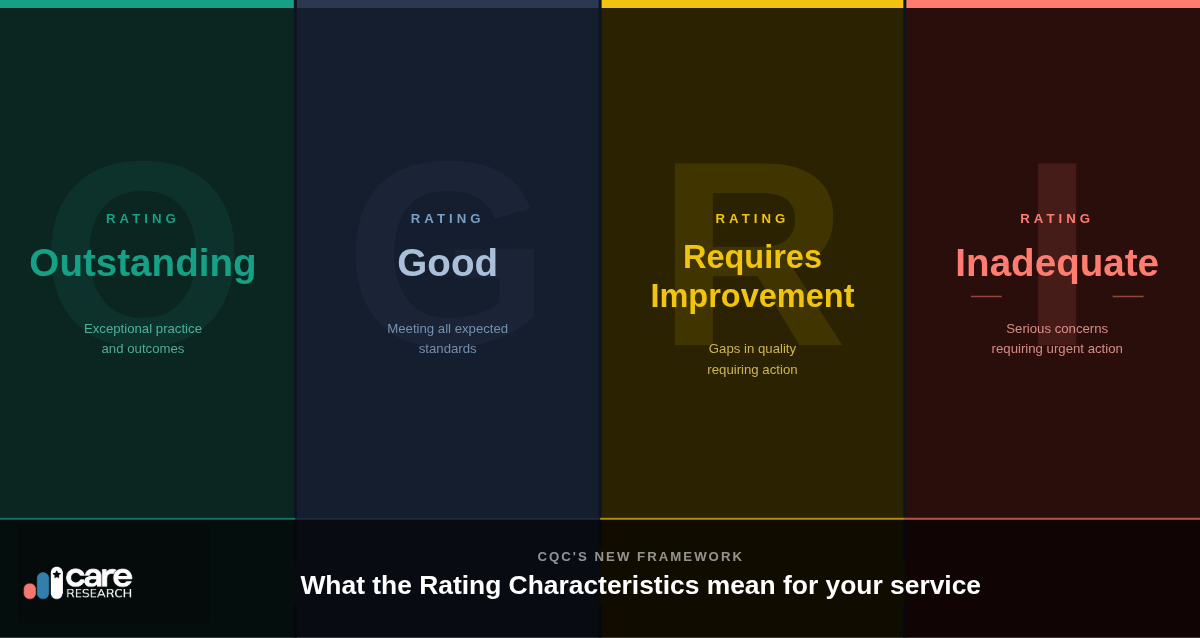
CQC have released draft sector-specific assessment frameworks for Adult Social Care, along with Rating Characteristics for each of the 24 Key Lines of Enquiry (KLOEs). These define what Outstanding, Good, Requires Improvement, and Inadequate look like for each KLOE.
Importantly, Adult Social Care now has its own set of Rating Characteristics, which is a genuinely positive step. It means the sector isn’t being measured against a generic yardstick. These characteristics are designed to be baked into the framework itself, not just guidance notes. They become the measuring stick.
This isn’t final. But it is direction – and providers who understand where this is heading will be in a much stronger position when the final framework lands.
What I think is working well
A few things genuinely stand out to me:
- Having clear definitions of Outstanding, Good, RI and Inadequate for each KLOE is hugely helpful. For too long, ‘Good’ has meant whatever the inspector in front of you defines it as. Common ground between providers and inspectors is long overdue.
- The inclusion of ‘I statements’ for each KLOE is a positive move. It grounds the framework in the experience of the person receiving care; which is where the focus should always be.
- The scope of each KLOE is now defined, which gives providers a clearer sense of what evidence actually belongs where.
My concern: the loss of scoring
I’ll be honest, this is the part that worries me most. The old SAF Key Question ratings with percentages were messy, and I’m glad they’re gone. But the scoring of individual Quality Statements was genuinely valuable, and I’m not sure the new framework has a replacement.
Here’s why it mattered:
- Visibility: You knew exactly which Quality Statements had gone well and which hadn’t.
- Transparency: Because each QS had to be scored separately, inspectors were required to actually look at each one – not just gravitate toward their preferred areas.
- Challenge: Services knew which Quality Statements to focus any report challenge on.
My recommendation, and what I’ll be writing in my consultation response, is that services should receive a rating (Outstanding, Good, RI or Inadequate) for each Key Line of Enquiry, not just at Key Question level. The Rating Characteristics exist precisely for this purpose. Even if CQC don’t make these KLOE ratings public, providers should at least receive them.
The consultation is open until 12th June. I’d encourage every provider to respond.
What this means right now for your service
These documents give us the clearest signal yet of where inspection is heading. The KLOEs aren’t changing drastically, but how evidence is measured and interpreted is shifting significantly. The Rating Characteristics are the new benchmark, and your team needs to understand them.
That means:
- Knowing which KLOE each piece of evidence belongs to
- Understanding what ‘Good’ looks like, in CQC’s own words, for each area
- Being able to articulate practice through the lens of the ‘I statements’
- Organising your evidence in a way that maps to the new framework, not the old one
When CQC walk in, it isn’t policies they test. It’s your people. And your people need to understand this framework before the inspector does.
How we’re helping providers get ready
At Care Research, we’re already rebuilding our Get CQC Ready training around these updates. So when the final framework is implemented, your team isn’t starting from scratch, they already understand what’s changed, what inspectors are looking for, and how to evidence it.
We’re offering two formats:
- In-person training at your service
- Live online sessions
For our online sessions, we find they work best with groups of up to around 25 attendees from the same provider. This keeps the session focused and makes sure every leader and manager gets the time and space to engage properly; it’s not a webinar, it’s a working session.
We’ve opened Super Early Bird booking now, with a limited number of places available before training begins in July (this date is somewhat fluid, and all training will commence once CQC have released the final updates). Booking early means you lock in the reduced price and get priority access to the first dates released.
If you want to understand this framework before your next inspection, now is the time to get ahead of it.