
On Thursday 18 June, more than 200 people came together online for our first Learning Disability Leaders Conference. It was completely free and from the very first session it became clear this was about more than a day of training. It felt like the start of something.
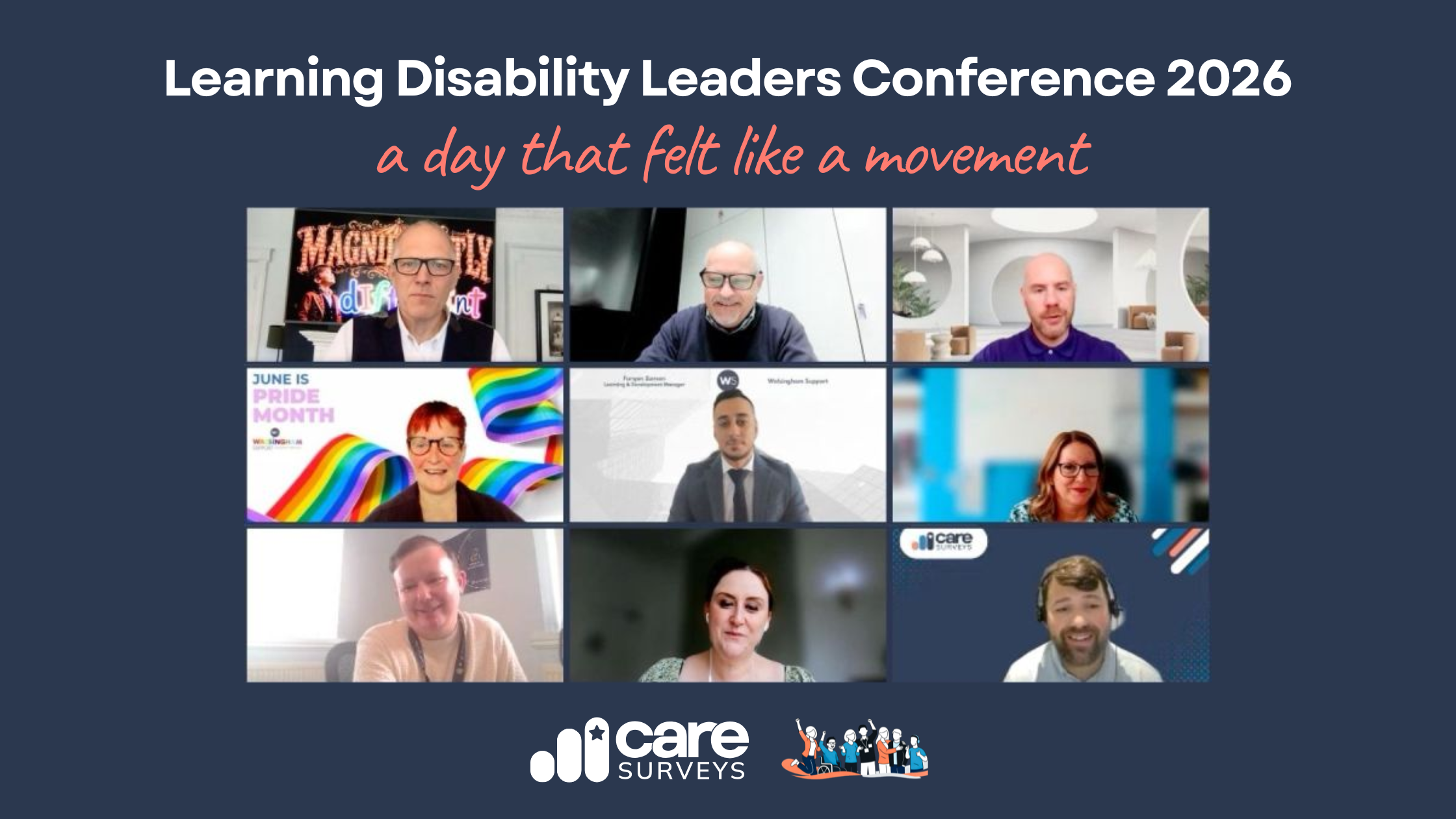
We set out to do one thing well: give a platform to the people doing the real work on the ground, and let the learning disability community be heard and respected. No sales pitches and no thinly disguised product demos. The closest thing to a pitch all day was our founder Louie introducing the event. That was a deliberate choice, and judging by your feedback, it was the right one.
Starting with a person, not a slide
Louie opened the day not with statistics but with Gary. Gary is in his 40s, has autism, and has lived in his supported flat for 18 years. We asked him a few simple questions about his life. What makes a really good day? “Dressing smart to see his girlfriend, watching the A-Team, and seeing dogs and telling them jokes.” What does he wish more people understood? His routine, and his traits.
It set the tone perfectly. Everything that followed came back to the same idea: real lives, real people, and care that starts with the person.
Magnificently Different: Big Ian Donaghy
There was no better person to open the day than Big Ian Donaghy. A former bouncer turned teacher, Ian spent eight years in a special school and, in his words, learned far more from the young people than they ever learned from him.
His message was about refusing to dumb things down. “These people deserve the best,” he said, describing how he made his lessons better and brighter rather than easier. He talked about stepping into someone else’s world rather than expecting them to step into yours, and about the danger of labels. In his now famous comparison, a dandelion and a rose are both flowers, but we decide one is precious and one is a weed. People are no different, the labels we give matter.
Moving, funny and full of heart, Ian did exactly what we hoped he would; he set the bar for the day.
Person-led, outcome-focused care planning: Tim Dallinger
Tim Dallinger of Social Care Consultants has been in social care since 1987, when his late wife, a social worker, brought two people home one Friday because there was nowhere else for them to go. Four decades of lived experience sat behind every point he made.
Tim’s session got practical about care records. We are good at teaching staff about GDPR and information governance, he said, but we rarely teach them how to actually write a good, person-centred record. His most striking idea: where a person is able and willing, why not support them to write their own care records?
Dementia in the learning disability population: Lin Spencer and Furqan Zaman
Lin Spencer and Furqan Zaman from Walsingham Support tackled an area that is under-resourced and poorly understood. People with a learning disability experience dementia at a significantly higher rate, and at a younger age, than the general population. Yet mainstream dementia policy and commissioning is largely built around people over 65, so the frameworks that work well for the wider population often are not fit for purpose here.
Their work began after a dementia summit, when Lin went back to her CEO and said simply, “We need to do more. We need to do better.” The result was a piece of research so thorough the original report ran to 146 pages. They shared the scale of the issue, the risk factors, what ageing in place really requires, and clear next steps for providers.
Where we are with Oliver McGowan training: Elaine Warner
Elaine Warner brought everyone up to date on the Oliver McGowan Mandatory Training, fittingly during Learning Disability Awareness Week with its theme of “See Me, Hear Me.” Between January and June alone, her organisation trained 1,672 people across healthcare, social care and dentistry.
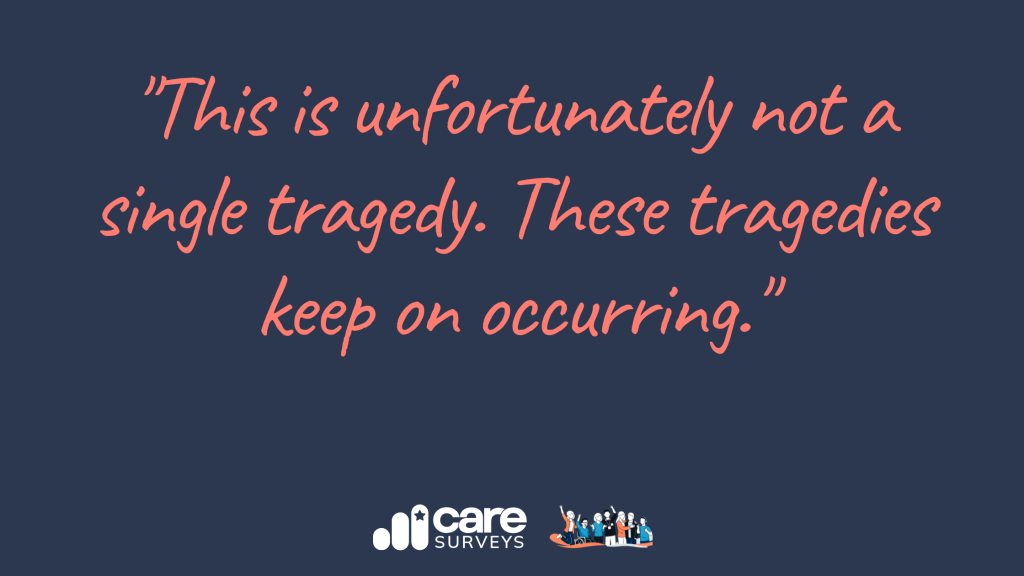
Elaine did some much needed myth busting, including the common belief that a service only needs Tier 1 training if it does not currently support anyone with a diagnosis. She covered the code of practice, the LDSS funding, and how to get onto the adult social care data set. Above all, she reminded us that Oliver’s story is not a single tragedy. These tragedies keep happening, which is exactly why the training matters.
Quality of life and PBS: Nick Witan
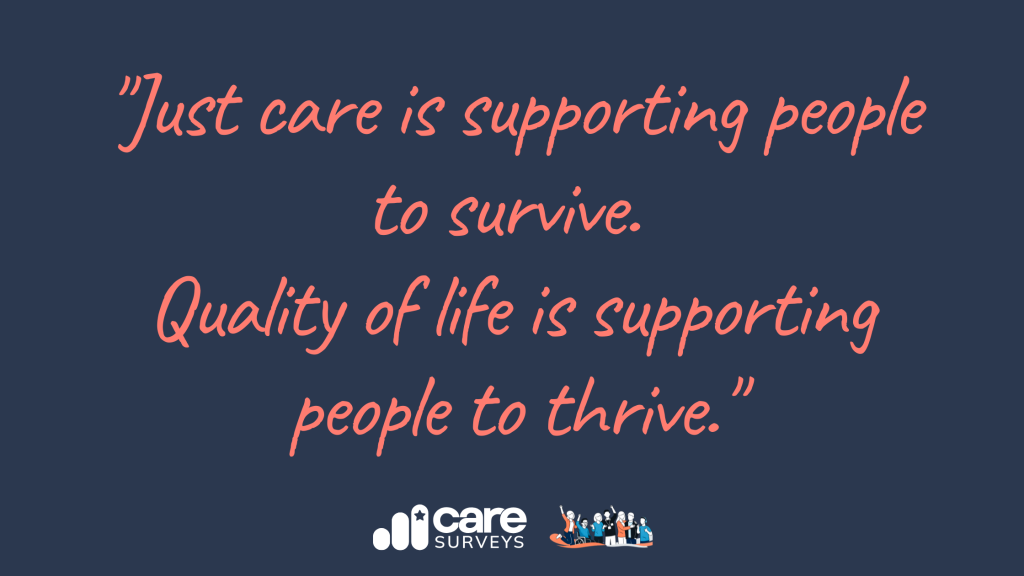
Nick Witan, founder of the Just Care Campaign and the Just Care Podcast, spoke with real passion about quality of life and Positive Behaviour Support. His campaign is about moving the sector beyond “just care,” where basic human needs are met, towards genuinely good lives.
Nick is a self-described “massive fan” of PBS and believes it is underused and under-appreciated, not as a tick-box framework but as a mindset. A challenging and encouraging session, just as Louie promised.
CQC, councils and the cost of care: Katherine Williams
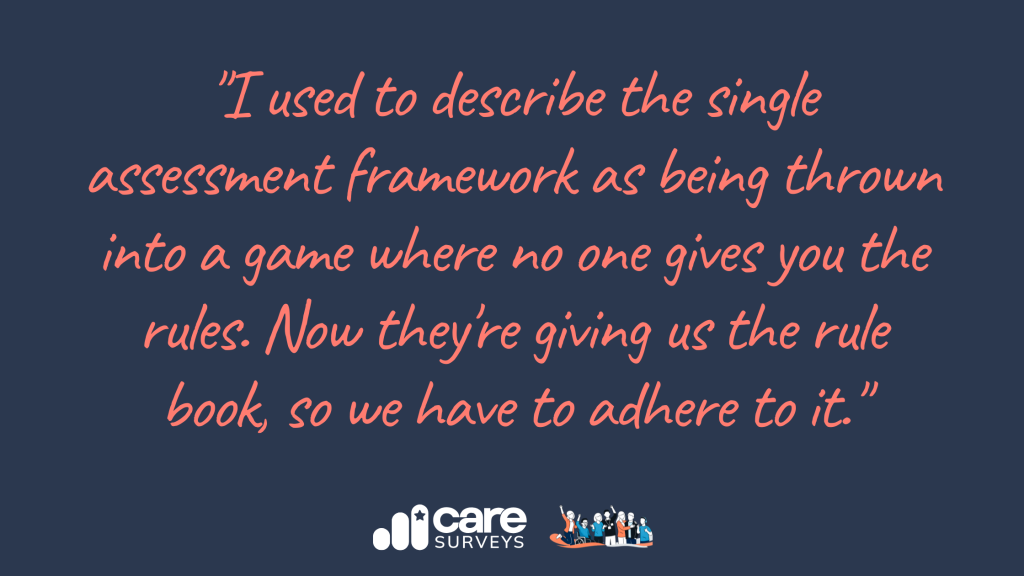
Katherine Williams of Fulcrum gave what Louie called an absolute tour de force on how to thrive with CQC, with a learning disability focus throughout. The headline is that big change is coming. The single assessment framework, with its scores and quality statements, is on its way out and will be gone completely by November. CQC is moving back to Key Lines of Enquiry, and a new inspection framework is being piloted now through to October. Where providers have the option of an inspection under the new framework, Katherine’s advice was to take it, because it is the clearest way to understand what is coming.
She also flagged a sharper focus on learning disability services, supported living and home care, a strong emphasis on outcomes, and September as a watershed month as CQC ramps up its activity. And she squeezed in the Deprivation of Liberty Safeguards (DoLS) changes published just 18 days earlier, which she described as the most significant shift in mental capacity law since the 2014 Cheshire West judgement. In England, CQC says the change takes immediate effect, so providers need to get familiar with it and adjust their practice now, while in Wales CIW is taking a more measured approach and advising providers to seek legal advice. A lot to take in, but exactly the kind of clear, practical steer providers need.
Reducing restrictive practice: Steven Lee
Steven Lee of Bright Futures closed the speaker sessions with an honest, straight-talking account of how his organisation has reduced restrictive practice in real terms over several years. No overnight fixes, just the highs, the lows and the challenges in between.
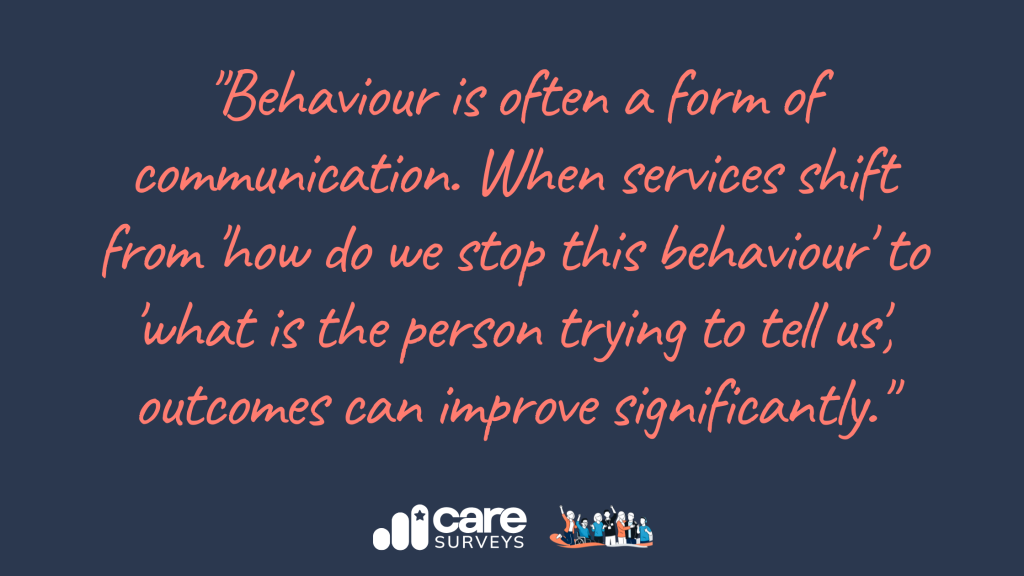
Drawing on 15 years in behaviour support, Steven walked through real case studies at both an organisational and an individual level, set against initiatives like STOMP and the work of the Restraint Reduction Network. People with a learning disability are more at risk of restrictive practice, and his session showed what it actually takes to change that.
Accessible feedback and hearing every voice: Louie Werth
Louie closed the day by pulling together a thread that ran through every session: how do we make sure people are genuinely heard? He began with a story about his grandmother. For 34 years the family called her Lisa, but when someone finally asked what name she wanted in her care plan, she chose “Elizabeth,” the name she was born with. One simple, direct question changed how she was seen.
From there he drew a distinction he keeps returning to: little feedback and big feedback. Little feedback is the day-to-day, what someone wants to wear or do, and most services do it brilliantly. Big feedback is the reflective kind; are you happy? Do you feel safe? Do you want anything to change? His point was that we cannot offer only little feedback to people with a learning disability while saving the deeper questions for everyone else. Some people will not raise the big things on their own, so it is on services to create the space, keep questions simple and accessible, and gather every voice rather than only the responses that are neatest to read. It was the closest thing to a pitch all day, and even that was really a case for what the whole event stood for: every voice matters.
What you told us
The response has meant the world to us. One attendee wrote to Louie afterwards:
“So often these things are just thinly-veiled sales pitches or are vague in nature, so you don’t come away with much. But I feel better informed about all sorts and really inspired. Genuinely, a wonderful event, thank you.”
There was plenty more in the same spirit. Lin Spencer called the team “awesome.” Chetna Satra found the sessions “both moving and motivating.” Shani Bradshaw described it as “a really valuable conference,” and Julie Turgoose simply said, “Loved it.”
Thank you
To our speakers, Big Ian Donaghy, Tim Dallinger, Lin Spencer, Furqan Zaman, Elaine Warner, Nick Witan, Katherine Williams and Steven Lee: thank you. Every one of you spoke with knowledge, passion and a real desire to see this community heard and respected.
The idea for this conference started on one fairly ordinary morning, but none of it would have happened without the Care Surveys team behind the scenes, pulling the whole day together, keeping the tech running, making everything look brilliant, and looking after every speaker along the way.
And thank you to everyone who joined us, dipped in and out, and got involved in the chat. This community deserves more, and we are proud to play our part in helping its leaders thrive and shine.
What’s next
Every talk was recorded. We will be sharing the session recordings and the resources from each speaker very soon, so if you missed anything, or want to revisit a session, keep an eye on your inbox.
This was our first Learning Disability Leaders Conference – it will not be our last.