
A former teacher on the school habits that make inspection-ready evidence part of everyday life, not a last-minute scramble.
By Emma Gold, Client Services & Project Coordinator at Care Surveys
I was an infant school teacher for 17 years, spanning Foundation Stage, Year One and Year Two. The more I learn about inspection-ready culture in care, the more I see connections and similarities with the education system.
As with most topics in the education sector, opinions around collecting and collating data and evidence vary. But there are habits in school life that care settings could borrow, adapt, and make their own. So here is a little cross-sector thinking that might spark something useful for your team.
“What happened today?”
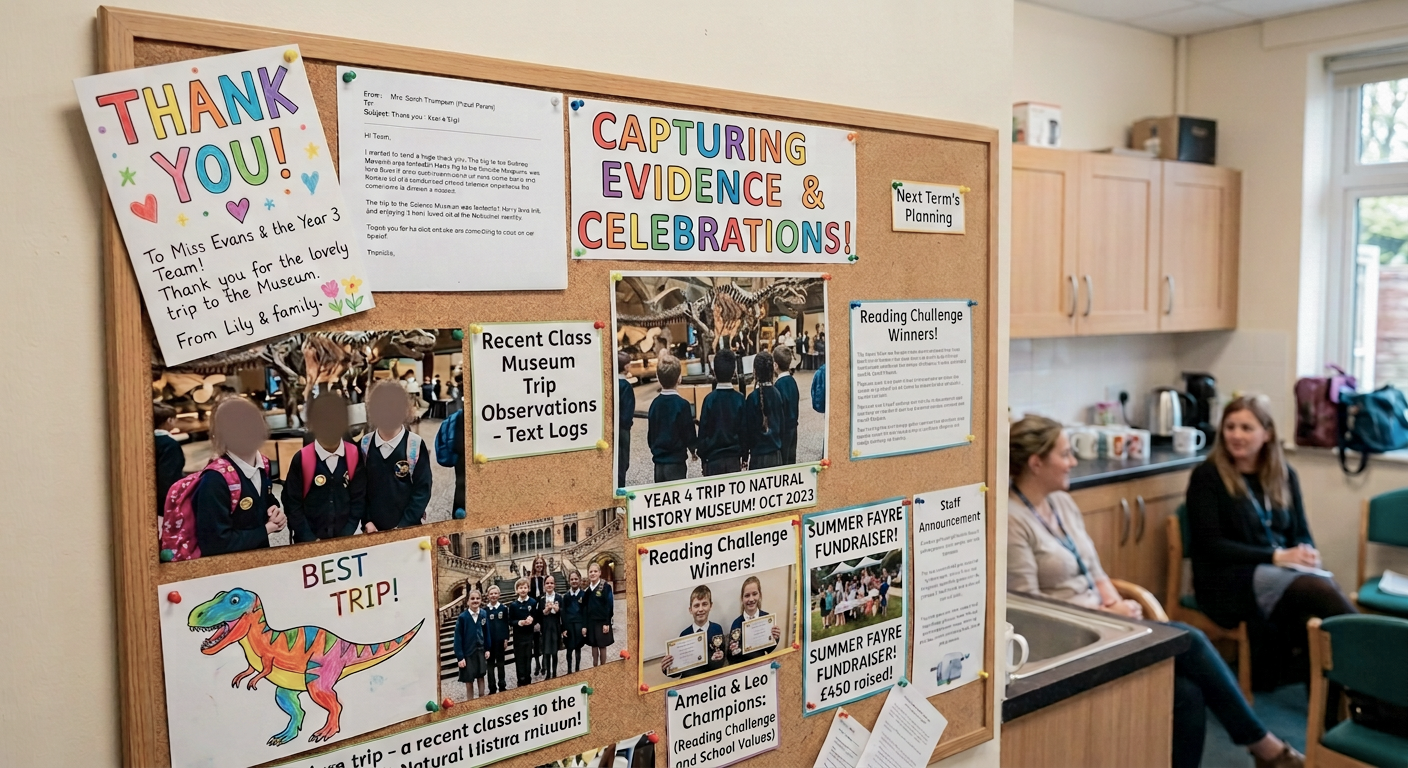
This is not just small talk – in schools, teachers are trained to document. A child has a breakthrough moment reading aloud? Write it down. A parent or carer sends a lovely email? Print it and pin it up. A class trip goes brilliantly? Photos go in the journal that very afternoon (the online journal, the actual physical photo album).
This is not bureaucracy, it is storytelling. And it is exactly what we mean when we talk about capturing evidence rather than creating it.
The difference matters. Creating evidence means scrambling before an inspection. Capturing evidence means your team’s work is already on record, waiting to speak for itself.
Five school habits worth stealing
1. The thank you board
In staff rooms and corridors, schools often display cards, notes and messages from pupils and their families. In a care setting, this could be a noticeboard in a shared staff area: compliments from residents, messages from families, little moments that made someone’s day. A post-it note with a quote, maybe only a couple of words, but someone’s words that genuinely mean something. Visible, celebrated, real.
2. The shared email culture
When a member of staff goes above and beyond in a school, someone forwards that email and the whole team sees it. In care, when a care colleague does something brilliant, a magic moment, a small win, is it shared? It should be.
3. The living journal
Many schools keep physical or digital journals of trips, visitors, projects and special days. Care settings can do the same: a folder – physical or shared online – of days out, activity sessions, themed events, even ordinary afternoons that were quietly lovely. Residents can browse it. Families can look through it when they visit. Inspectors can see a life being lived, not just a care plan being filed.
And it is 2026, so the living journal now stretches across every social media platform you can imagine. Did you see the care home whose residents recorded good luck messages for the England football team? That’s person-centred, living evidence in action.
4. The communal screen
Got a TV or screen in a shared lounge? A simple rolling slideshow of photos, outings, celebrations, staff and residents during everyday moments, does more to show what life is like in your service than a hundred words of documentation ever could. And like children, I guarantee there is a resident somewhere waiting for the photo of themselves to appear.
5. The monthly round-up
Schools write newsletters. Care settings can write short internal summaries: this month we tried, this season we celebrated, this week someone told us. These are not reports for the regulator. They’re proof that your service has a heartbeat.
This isn’t just a manager’s job
Here is something schools get right that care settings sometimes struggle with: evidence gathering isn’t owned by one person. It is everybody’s job.
A teaching assistant notices something a teacher missed. A lunchtime supervisor sees a child blossom in a way that never happens in the classroom. The same is true in care. The person doing the morning routine sees something different from the person on the afternoon shift. The activities coordinator hears things the manager never will. A night care colleague witnesses quiet moments of comfort and connection that no one else is around to see.
If capturing evidence sits only with managers, you are missing most of the story.
The goal is a culture where anyone, at any level, feels able to say, “that was worth recording” and knows exactly how to do it. Simple, low-barrier ways to share: a dedicated email address, a shared folder, a WhatsApp group that feeds into something more formal. The method matters less than the habit.
This isn’t about adding to anyone’s workload
Time is precious and everyone in a care setting knows that. The most important thing, always, is the person-to-person contact. Staff should not be walking around with clipboards gathering soundbites from residents, checking boxes and making notes mid-conversation.
But capturing small, incidental moments in a variety of ways can and should become common practice. A quick photo. A two-line note at the end of a shift. A voice note. A shared message. Getting this right isn’t about creating more work, it is about making the work that’s already happening visible.
The real question inspectors are asking
Whether it is Ofsted walking into a school or an inspector visiting a care service, the underlying question is the same: What is it actually like here?
A one or two-day inspection cannot capture everything you do. That’s why the evidence you have gathered, the notes, the photos, the journals, the stories, does the talking for you.
Your team creates magic moments every single shift, at every hour of the day. The only question is: are you capturing them?
How Care Surveys can help
Building this kind of evidence culture takes more than good intentions, and that is where we come in. Our Care Staff Confidence and Get CQC Ready training programmes teach teams exactly this distinction: capturing evidence as it happens, rather than creating it under pressure before an inspection. We work with frontline staff and managers to build the habit, not just the paperwork.
And once your team is capturing those moments, our managed survey platform, Care Surveys, turns ongoing feedback from residents, families and staff into CQC-aligned reports you can actually use, so the living journal your team builds day to day is backed by structured evidence when it matters most.
Ready to build an evidence culture that works all year round? Get in touch with the team to find out more.